The Writing Kit Plan
Choose, supply and carry the pens and pencils you write with: the nib by its millimeters, paper by dry time, a pencil grade per job, a year of ink by the page, spares for a trip, a pocket kit under 90 g, and a pen that stays balanced
MechPen's tools each answer one question. The Nib Size Converter shows that a Japanese Medium writes about 0.5 mm, the line of a Western Fine. But the Ink Dry-Time Estimator and the Ink Refill Life Calculator read the letter on the nib, so a Japanese M goes in as a Medium and comes out with a Medium's flow; and nothing joins the refill calculator, which knows how many pages a fill writes, to the carry-weight calculator, which knows what each spare weighs. The Writing Kit Plan chooses your next nib by the width of the line you already like, not the letter on it, then carries that width through paper, dry time and ink. It sets one pencil grade per job with a test strip from your own maker, counts a year of ink by the page, packs the spares a trip needs, holds the kit under the calculator's 90 g pocket line, and checks whether posting the cap tips the pen back-heavy. In the worked example, buying by the letter would have meant a nib 40% wider; chosen by width, the line on Tomoe River type paper dries in 12.3 s rather than 17.6 s, a 50 mL bottle lasts 416.7 days, and a 5-day trip needs 2 cartridges, not the box of six. Every figure is computed by the site's own tools and the worked kit is an example, tagged as such; nib sizes and pencil grades differ between makers, and the plan says so. It covers keeping ink and cleaning solutions away from children, and using ammonia-based pen flush with ventilation and gloves. You get a 24-page printable PDF with seven steps, four working pages, a reference table and a quickstart, plus a personalised sheet worked from the numbers you enter in any of the seven tools.
Look inside
Two full pages from the plan, exactly as printed. Click either to read it at full size before you decide.
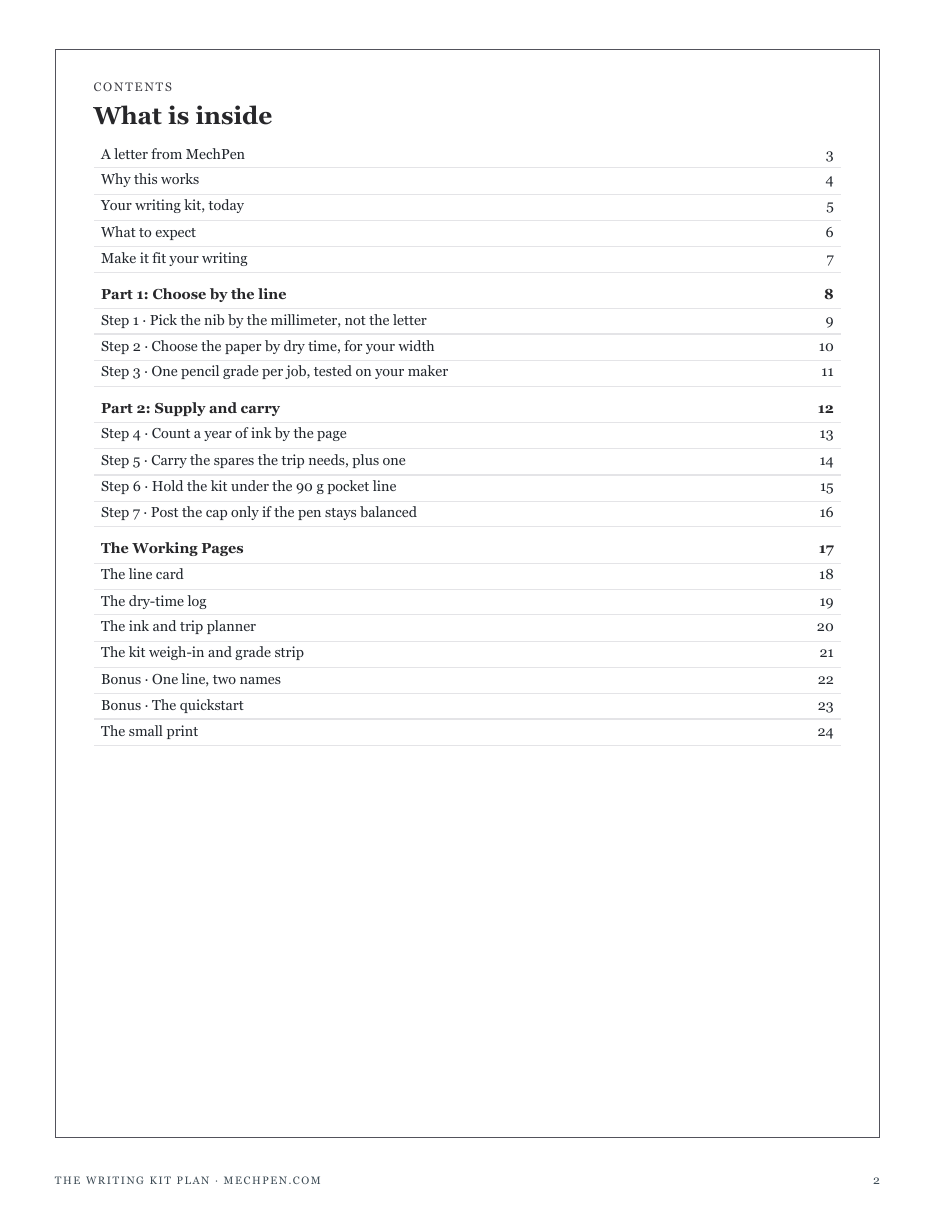
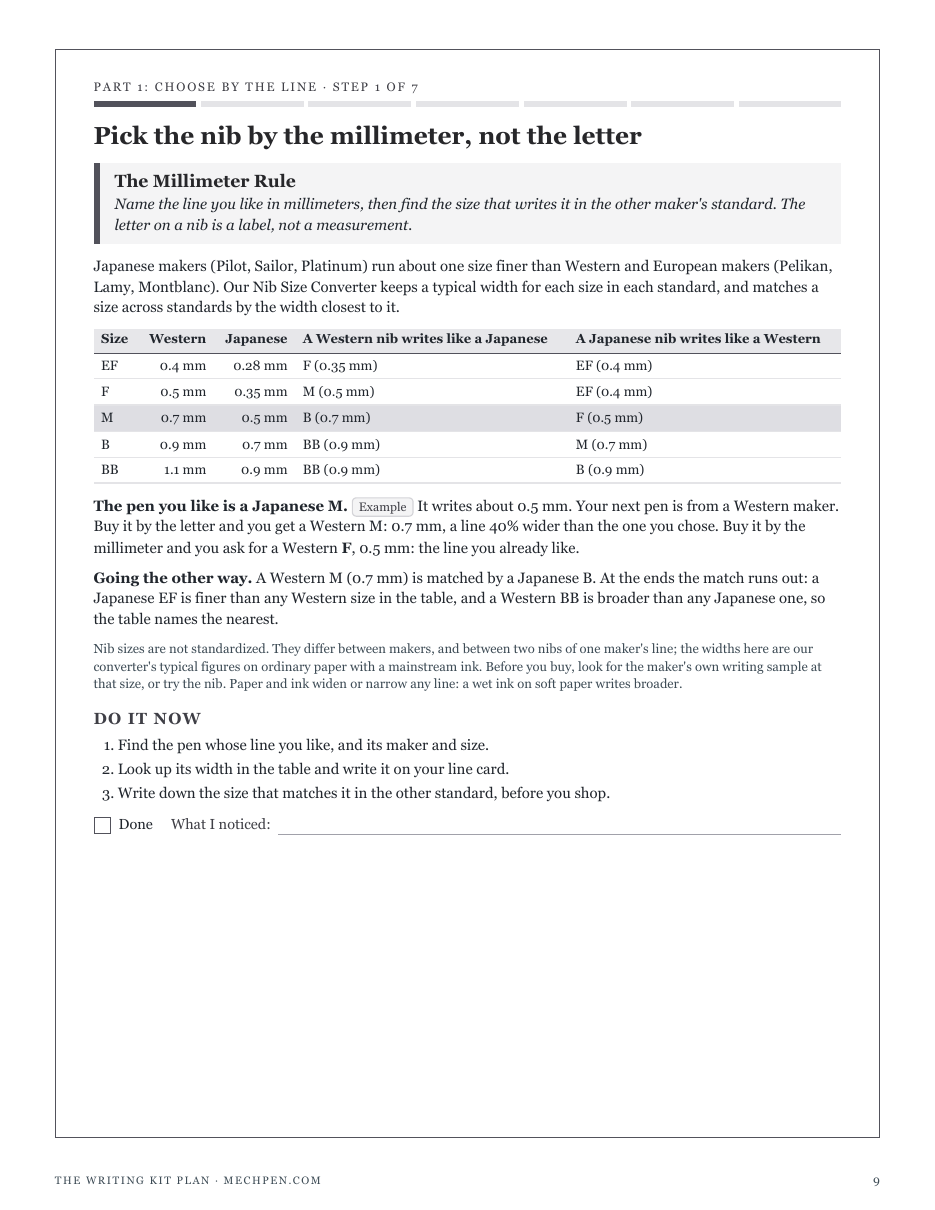
What is in it
- The Millimeter Rule: the next nib chosen by the width of the line you like, with every size in Western and Japanese sizing
- The Dry-Before-Drag Rule: paper chosen by dry time for your nib's real width and your room's humidity
- The One-Grade Rule: a pencil grade per job, and a test strip of the grade either side from your maker
- The Page-Count Rule: a year of ink by the page, in cartridges, milliliters and days per bottle
- The Start-Full Rule: the spares a trip really needs, plus one, and flying with a fountain pen
- The 90-Gram Line: the kit weighed against the pocket line, heaviest line changed first
- The Posting Rule: whether posting the cap tips the pen back-heavy, and the heaviest cap it can take
- Four working pages: a line card, a dry-time log, an ink and trip planner, and a kit weigh-in with a grade strip
- One line, two names: a reference of every nib by width, dry time, ink per page and pages per cartridge
- A personalised sheet worked from the figures you enter in the nib, dry-time, refill, pencil, carry-weight and balance tools
- ✓ 24 printable pages
- ✓ 10 sections, worksheets and templates
- ✓ A second PDF worked out from the numbers you enter
- ✓ No account needed, just an email address
- ✓ Instant download; link valid 7 days
Price includes any taxes. Sold by GrabURL, who handle checkout and support. The charge appears on your statement as GrabURL.
The plan picks up where the free Nib Size Converter leaves off. The converter shows that a Japanese Medium lays the line of a Western Fine; the plan carries that width through the Ink Dry-Time Estimator and the Ink Refill Life Calculator, which read the name on the nib, so paper, dry time and ink supply follow the line you actually write. It picks a pencil grade per job with the Pencil Lead Hardness Selector, counts the spares a trip needs, holds the kit under 90 g with the EDC Carry-Weight Calculator, and checks whether posting the cap tips the pen. Nib sizes and lead grades differ between makers, and it says so. It covers keeping bottled ink and cleaning solutions away from children and using ammonia-based pen flush with ventilation and gloves. The worked figures are examples.